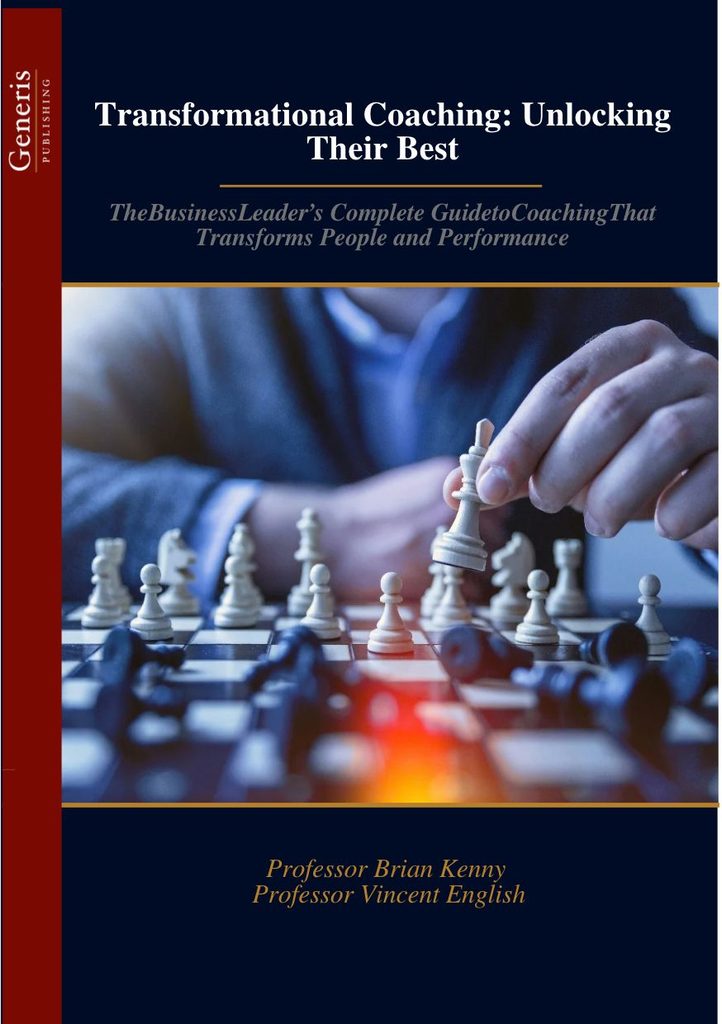
The Art and Practice of Business Coaching
A practical exploration of professional coaching, leadership development, organisational behaviour, emotional intelligence and the business of coaching.
Fourteen chapters. Fourteen interactive simulations. One comprehensive learning journey.
Explore the ChaptersAbout the Book
Business coaching is much more than helping managers solve problems or improve their professional performance. At its best, coaching establishes a relationship in which another individual can think more clearly, challenge assumptions, develop greater self-awareness and discover their own capacity for meaningful change.
This book provides a comprehensive introduction to the philosophy, psychology, practical skills and ethical responsibilities of professional business coaching. It explores the personal qualities required of effective coaches and examines how coaching relationships can support leadership development and organisational improvement.
The early chapters examine common coaching misconceptions, the importance of self-awareness, the development of trust, effective listening, powerful questioning and emotional intelligence.
The middle chapters explore coachability, coaching-oriented leadership, professional ethics, reflective practice and the design of successful coaching relationships.
The final chapters examine the commercial realities of building a coaching practice, the influence of organisational culture, and the future of coaching in a world increasingly shaped by artificial intelligence and digital technologies.
To complement the book, 5G Global has developed an interactive learning simulation for every chapter. These applications allow readers to apply theoretical concepts to realistic management situations, make coaching decisions, examine alternative approaches, assess their capabilities and develop practical improvement plans.
Readers are encouraged to study each chapter before completing its associated simulation. The result is an integrated learning experience that connects knowledge, reflection and professional practice.
Explore the Fourteen Chapters
Discover the central ideas of each chapter and then launch its associated interactive coaching simulation.
The Coaching Myth: Why Most People Get This Wrong
The opening chapter challenges widespread misconceptions about coaching and examines why many well-intentioned managers misunderstand what effective coaching actually involves.
It distinguishes coaching from mentoring, consulting, advising and traditional management. Readers examine the temptation to offer solutions, demonstrate expertise or rescue clients from difficult situations.
The chapter demonstrates why the coach’s principal responsibility is not to provide all the answers but to create the conditions in which clients can discover new insights, develop independence and take responsibility for their own decisions.
The Inner Game: Knowing Yourself Before You Coach Anyone Else
Effective coaching begins with self-awareness. Coaches bring their own beliefs, experiences, assumptions, emotional reactions and values into every professional relationship.
This chapter explores how unconscious biases and personal preferences can influence the coaching conversation. It encourages practitioners to become more aware of their own emotional patterns and recognise when their responses are driven by personal needs rather than the client’s interests.
Reflective practice and honest self-examination are presented as essential foundations of professional coaching competence.
The Trust Equation: Building the Foundation for Real Coaching
Trust provides the essential foundation for meaningful coaching conversations. Without trust, clients are unlikely to explore their vulnerabilities, question established beliefs or discuss the issues that genuinely matter to them.
The chapter examines credibility, reliability, personal connection, confidentiality and the influence of the coach’s self-orientation.
Readers explore how trust is established, maintained and occasionally damaged. They also consider how professional consistency, honesty and respectful communication can repair relationships when trust has been weakened.
The Art of Listening (And Why You’re Probably Not Very Good at It Yet)
Listening is one of the most important capabilities in professional coaching. Yet many individuals listen primarily to prepare their response rather than to understand another person’s experience.
The chapter explores different levels of listening, the interpretation of non-verbal signals, the importance of attention and the constructive use of silence.
Readers learn to identify the distinction between hearing information and listening for meaning, emotion, hesitation and the unspoken assumptions that influence an individual’s thinking.
The Power of Questions: The Coach’s Most Potent Tool
Questions are among the most powerful instruments available to a coach, but their effectiveness depends on their purpose, timing and formulation.
This chapter examines how closed, leading, judgmental and overly complex questions can restrict a client’s thinking or subtly direct them towards the coach’s preferred conclusion.
It introduces approaches to questioning that generate awareness, explore values, challenge assumptions, identify possibilities and support meaningful action. The GROW framework provides a flexible structure for purposeful coaching conversations.
Emotional Intelligence in the Coaching Room
Coaching conversations involve emotions, aspirations, uncertainty, fears and beliefs as well as professional objectives. Emotional intelligence enables coaches to recognise these dimensions and respond to them appropriately.
The chapter explores self-awareness, self-regulation, motivation, empathy and social skills. Readers examine how emotional signals can provide valuable information about the client’s experience.
Particular attention is given to managing difficult emotions, remaining present under pressure, balancing empathy with challenge and recognising the professional boundary between coaching and therapy.
Coachability: Working with What You’re Given
Not every individual arrives at coaching ready or willing to participate fully. Some clients are sceptical, defensive or attending because their organisation has instructed them to do so.
This chapter challenges the assumption that coachability is a fixed personal characteristic. Instead, it examines how willingness, capacity, trust, timing and organisational circumstances influence a person’s readiness to engage.
Readers learn to treat resistance as information, respect individual autonomy, build a constructive relationship and recognise when coaching may not be the appropriate intervention.
Leadership and Coaching: The Leader as Coach
Successful managers are often experienced problem-solvers. However, repeatedly solving problems for employees can create unnecessary dependence on the manager.
This chapter explores the transition from directive leadership towards a coaching-oriented management style. It demonstrates how thoughtful questions, active listening, employee ownership and developmental conversations can build stronger teams.
Readers also examine the responsibilities of managerial authority, the difference between coaching and instruction, and the development of a sustainable organisational coaching culture.
The Ethics of Coaching: Doing Right by Your Clients
Ethical responsibilities are present throughout every coaching relationship. Coaches must operate with integrity, maintain confidentiality, recognise the boundaries of their competence and protect client autonomy.
This chapter examines the ethical challenges that arise when coaches work with individual clients and sponsoring organisations whose expectations may not always align.
Readers explore conflicts of interest, confidentiality, three-way contracting, psychological safety, informed consent, professional supervision and the importance of knowing when specialist support is required.
Reflective Practice and Supervision: The Coach Who Never Stops Learning
Professional coaches develop through more than experience alone. Meaningful improvement requires systematic reflection on decisions, assumptions, emotions and their impact on clients.
This chapter introduces structured reflective practice, including the six stages of Gibbs’ Reflective Cycle. It explains how coaching journals and thoughtful self-examination can transform experience into learning.
The chapter also explores the normative, formative and restorative functions of supervision, ongoing professional development and the importance of maintaining the coach’s own wellbeing.
Designing the Coaching Relationship: Contracts, Goals, and the Architecture of Change
The quality of a coaching relationship is strongly influenced by the foundation established before substantive coaching work begins.
This chapter explains why contracting is more than an administrative exercise. It distinguishes practical, working and developmental agreements, and explores how expectations, confidentiality, boundaries and responsibilities should be established.
Readers also examine developmental goal-setting, the difference between presenting and underlying goals, relationships with sponsoring organisations, progress reviews and the appropriate sequencing of coaching engagements.
Building a Coaching Practice: From First Client to Flourishing Business
Being an effective coach and operating a successful coaching practice require different but complementary capabilities.
This chapter explores the commercial foundations of professional coaching. Readers learn to define a niche, establish distinctive market positioning, attract clients, communicate their value and build a trusted professional reputation.
Particular attention is given to pricing strategies, coaching packages, financial planning, operational systems, professional insurance, corporate partnerships and the long-term sustainability of an independent practice.
Organisational Culture and the Coaching Relationship: When the System Is in the Room
Coaching does not take place independently of organisational culture. The values, assumptions and unwritten rules operating within a workplace can strongly influence what individuals feel able to say and do.
This chapter explores Edgar Schein’s three levels of organisational culture: visible artefacts, espoused values and underlying assumptions.
Readers examine organisational politics, psychological safety, cross-cultural coaching and the possibility that an apparent individual performance problem may actually reflect a deeper systemic organisational issue.
The Future of Coaching: What Comes Next and Why It Matters
The final chapter examines how professional coaching is evolving in response to artificial intelligence, digital technologies and changing expectations of organisational leadership.
It explores how technology can expand access to coaching, support reflection, track developmental progress and make coaching available to a wider population.
At the same time, it emphasises the continuing importance of human empathy, professional judgment, genuine presence, cultural awareness and ethical responsibility.
Readers consider how future coaching services can combine technological innovation with the distinctive qualities of effective human relationships.
From Understanding to Application
The fourteen interactive simulations transform the book’s central ideas into practical learning experiences. Each simulation encourages readers to make decisions, examine alternative approaches and reflect on the consequences of their coaching choices.
Whether you are an experienced executive coach, a business leader, a practising manager or a student beginning your coaching journey, the 5G Global Coaching Intelligence Lab provides a structured opportunity to convert theory into professional practice.
Explore the chapters, complete the simulations and use the practical learning tools to develop your own coaching knowledge, confidence and capability.
Visit 5G Global